
Technical Analysis of Conical Airbag Powder Material Transport Trucks for Bulk Cement and Fly Ash Logistics

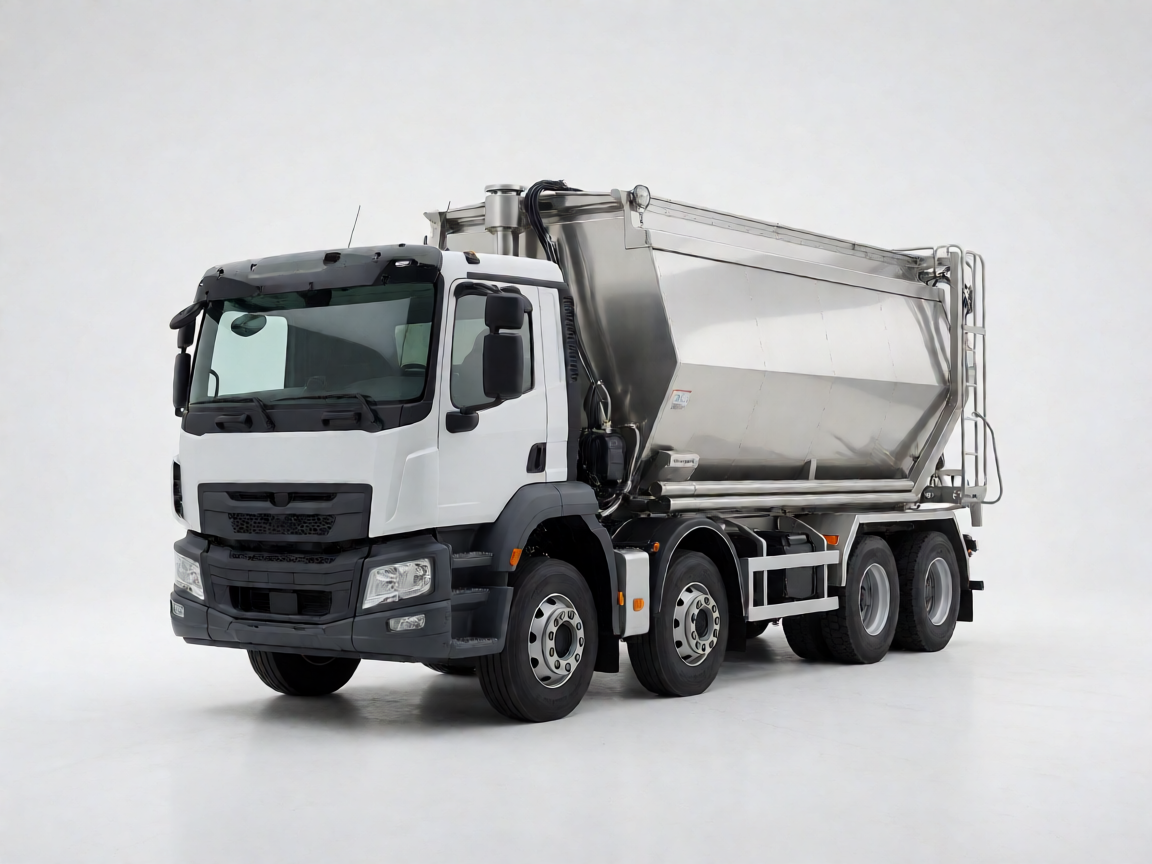
powder material transport truck Safety Overview
Conical Airbag Tank Design for Bulk Powder Transport
The powder material transport truck represents a specialized class of bulk liquid and powder hauling equipment engineered for high-volume cement, fly ash, and micro-powder logistics operations. Unlike conventional cylindrical tank trailers, the conical airbag configuration addresses longstanding industry challenges around residual material retention, cleaning cycles, and payload efficiency.
Engineers at Sinotruk Liuzhou Yunli completed the development of a conical airbag-type powder material transport truck that integrates a lightweight tank structure with a high effective-volume utilization ratio. The design targets operators who move large volumes of dry bulk commodities over medium-to-long haul routes where turnaround time and fuel cost per ton-kilometer directly affect fleet economics.
Structural Configuration and Discharge Mechanics
The tank body employs a double-cone geometry at the discharge end rather than the flat-bottom or single-slope arrangements found on older designs. This configuration creates a natural material-flow funnel that directs bulk powder toward the central discharge port without requiring high-pressure fluidization across the entire tank floor.
Airslide fabric panels line the tank interior along the conical sections. These porous membrane strips allow compressed air to pass through evenly while preventing powder particles from escaping. When the system operates, pressurized air enters through manifold piping and fluidizes the material bed adjacent to each airslide panel. As a result, the powder behaves like a viscous fluid and moves toward the cone apex under gravity.
The conical geometry therefore reduces the active fluidization area compared to flat-bottom designs. Operators supply less compressed air to achieve the same discharge rate, which in turn lowers compressor runtime and fuel consumption during unloading cycles.
Tare Weight Reduction Through Optimized Materials
The tank body construction utilizes high-tensile steel plates with controlled thickness distribution. Engineers place thicker gauge material only at high-stress zones such as the cone apex, mounting brackets, and pressure-rated inspection ports. Meanwhile, lower-stress regions receive thinner plates that still meet structural integrity requirements under full load conditions.
As a result, the overall tare weight drops relative to conventional powder transport trucks of equivalent容积. A lighter chassis leaves more payload capacity within gross vehicle weight limits, which allows each trip to carry more commodity without exceeding axle load regulations.
For fleet operators, the tare weight difference translates directly into additional revenue trips or reduced fuel burn per ton delivered. Over a 12-month operational cycle, the payload gain alone often offsets the acquisition premium of a purpose-built conical airbag unit.
Effective Volume Utilization and Cleaning Efficiency
The conical discharge section also improves effective volume utilization. Flat-bottom tanks frequently leave 3 to 5 percent of cargo residue clinging to the floor corners and dead zones near the walls. The conical airbag design minimizes these stagnation areas by guiding material continuously toward the discharge port.
Cleaning cycles therefore require fewer water washes or manual intervention between loads. Operators switching between cement grades or fly ash batches experience shorter turnaround times at the discharge terminal, which increases daily trip potential.
In addition, the smoother internal surface finish reduces powder adhesion. Surface treatments applied during manufacturing create a low-friction coating that further limits material buildup on tank walls.
Operational Economics and Fuel Savings
Fuel consumption forms a major component of total cost of ownership for bulk powder haulers. The powder material transport truck with conical airbag tank delivers measurable fuel savings through two mechanisms: reduced tare weight and shorter unloading cycles.
Lower vehicle mass decreases rolling resistance and engine load during transit. For example, a tare weight reduction of 800 kilograms on a fully loaded combination can save approximately 0.3 to 0.5 liters of diesel per 100 kilometers, depending on route gradient and traffic conditions.
Meanwhile, the faster discharge rate enabled by the conical airbag system shortens terminal dwell time. Shorter stops mean the engine idles less and auxiliary air compressors run for fewer minutes per unload event. Over hundreds of stops per month, these incremental savings accumulate into significant fuel cost reductions.
Total Cost of Ownership Comparison
When evaluating competing bulk transport solutions, fleet managers should compare total cost of ownership rather than purchase price alone. The conical airbag powder material transport truck carries a higher upfront cost than a standard cylindrical tank trailer, but the payload advantage and operating efficiency typically recover the premium within 18 to 24 months of regular service.
Key factors in the economic analysis include average route length, cargo density, terminal throughput constraints, and local fuel pricing. Operators running short-haul dense-cement routes see faster payback than those on long-haul low-density fly ash runs, simply because payload capacity drives more revenue per kilometer in the former case.
Maintenance Requirements and Service Intervals
The airslide fabric panels represent the critical wear component in the conical airbag system. Operators should inspect these membranes at every scheduled service interval for abrasion, clogging, or delamination from the support structure. Clogged airslide zones cause uneven fluidization and can trap material in localized pockets, which undermines the discharge efficiency the design intends to improve.
Compressed air quality also affects long-term reliability. Moisture-laden air condenses inside the tank and cakes fine powder into hard deposits. Air dryers and moisture separators installed on the compressor circuit prevent this condition and extend airslide fabric life.
Pressure relief valves, discharge gate actuators, and manifold fittings require periodic testing to verify correct cracking pressure and sealing performance. Dealers servicing these units should follow the manufacturer torque specifications and seal replacement schedules rather than relying on field judgment alone.
Component Replacement Guidelines
Airslide fabric replacement depends on operating intensity and cargo type. Cement grinding aid additives accelerate fabric wear compared to plain Portland cement. Operators handling high-additive blends should plan fabric replacement at 18 to 24 month intervals, whereas plain cement service may extend that window to 30 months or beyond.
Discharge gate seals and actuator bushings show wear proportional to cycle count. Each loading and unloading event adds mechanical stress to the gate mechanism. Preventive replacement of worn seals before leakage occurs avoids material spillage and maintains regulatory compliance at weighing stations.
Application Scope and Cargo Compatibility
The conical airbag powder material transport truck serves three primary cargo categories: Portland cement and blended cements, Class F and Class C fly ash, and ground granulated blast-furnace slag powder. Each material exhibits different flow characteristics, and the tank design accommodates these variations through adjustable airslide zoning and variable manifold pressure settings.
Operators transporting abrasive materials such as silica flour or certain mineral fillers should verify airslide fabric compatibility with the specific particle size distribution. Coarse-grained cargoes accelerate fabric erosion and may require reinforced mesh supports beneath the porous membrane.
Temperature-sensitive shipments do not present special challenges for this design, since the conical airbag system relies on atmospheric-pressure compressed air rather than heated fluidization. However, operators moving materials prone to moisture absorption should ensure tank ventilation provisions prevent condensation accumulation during climate transitions.
Design Evolution and Industry Adoption
Traditional powder transport tanks evolved from liquid chemical tanker configurations adapted for dry bulk use. The transition to purpose-built conical airbag designs reflects lessons learned from decades of field operation data. Manufacturers now optimize tank geometry, airslide layout, and structural framing based on actual material flow behavior rather than generic pressure vessel standards.
Quality management systems such as IATF 16949 underpin component manufacturing for these specialized vehicles. Certification audits verify that subSupplier processes for steel forming, welding, surface treatment, and airslide integration meet defined control plans. As a result, batch-to-batch consistency improves and warranty claims related to structural defects decline.
The commercial vehicle sector continues to refine bulk powder transport equipment as emission regulations tighten and logistics operators demand higher asset utilization. The conical airbag powder material transport truck represents one evolution path that prioritizes payload efficiency and operating cost reduction over simple capacity increases.
Maintenance Recommendations for Fleet Operators
Fleet maintenance managers should establish documented inspection routines for conical airbag tanks. Monthly checks should include airslide panel condition assessment, discharge gate operation verification, and compressed air system moisture inspection. Quarterly evaluations should add manifold pressure distribution testing and tank internal visual examination through inspection ports.
Record keeping matters for warranty validation and predictive maintenance planning. Operators who log airslide replacement intervals, gate seal service dates, and compressor maintenance events gain visibility into component lifecycle trends. These records also support resale value preservation when trading in older units.
Finally, dealer technical support networks play a critical role in long-term reliability. Operators should confirm regional service coverage and spare parts availability before committing to a particular powder material transport truck model. Prompt access to airslide fabric, gate actuators, and manifold components reduces downtime during unexpected failures.


